This is from the “Accounting Makes Cents” podcast episode #125 released on Monday, 2 November 2026.
Now, before we get into today’s topic, I have a little milestone to share. This episode marks the fifth year of Accounting Makes Cents! I usually take a little break around this time of year, so I tend to mark the podcast anniversary around the same time. And here we are, five years later!
It’s quite something when I think about it. Five years of discussing accounting theories, financial management, business strategy and all those concepts that we sometimes love to hate!
And if you’ve been listening along the way, thank you for being part of this journey. Whether you’ve been here since the very beginning or you’ve only recently discovered the podcast, I really appreciate you taking the time to listen.
And to show my appreciation, I’ve teamed up with Astranti to offer you a discount code, which you can use to get 10% off selected products and courses on their website. This is where you find the code.
Anyway, since we’re celebrating five years, I thought we’d keep things real today. Quite literally, actually!
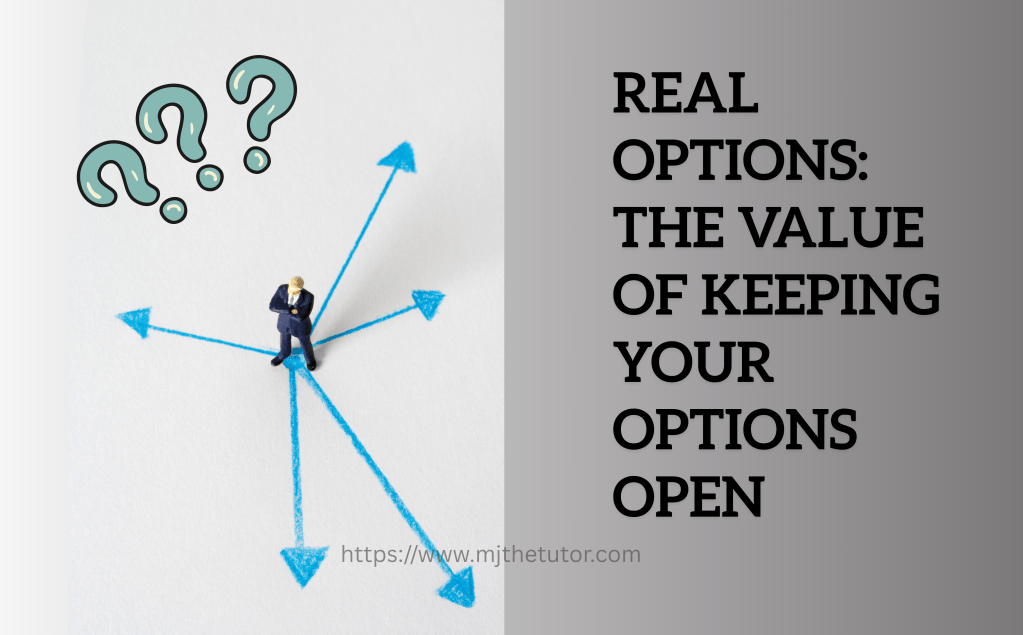
We’re going to talk about something called Real Options.


Jump to show notes.
Now, before you start thinking this is another complicated financial model that requires a spreadsheet and a strong cup of coffee, please bear with me.
The concept is actually quite interesting, and it starts with something many of us have probably experienced: making a big investment and wondering whether we should commit now or keep our options open.
So, I think let’s start there.
A LITTLE EVERYDAY SCENARIO
Imagine you’re thinking about buying an electric vehicle.
You’ve been doing your research, comparing different models, looking at prices and calculating how much you could potentially save on fuel and maintenance.
And, on paper, it all looks quite promising.
But then you start thinking about the things you’re not entirely sure about.
Will there be enough charging stations in your area? Will electricity prices remain attractive compared with fuel? What if battery technology improves considerably over the next couple of years? And what if you discover that owning an electric vehicle simply doesn’t suit your lifestyle?
Suddenly, you’re not quite as confident about making that purchase.
Now, let’s say you have another option. Instead of buying the vehicle outright, you decide to lease one for a year.
Yes, it might cost you a little more in the short term. But at the end of that year, you’ll have a much better idea of what owning an electric vehicle is actually like.
You’ll know how convenient charging is, what your running costs look like and whether the vehicle meets your needs.
And then you can decide what to do next.
Perhaps you’ll purchase an electric vehicle. Perhaps you’ll continue leasing. Or perhaps you’ll decide that an electric vehicle isn’t for you after all.
The point is, you haven’t committed yourself to a substantial purchase before you have all the information you need.
You’ve given yourself some flexibility.
And that’s really what I want you to take away from this example.
Sometimes, the ability to delay a decision, gather more information and make a choice later can have considerable value.
And in financial management, this brings us to the concept of real options.
SO, WHAT ARE REAL OPTIONS?
In everyday language, an option is simply a choice. You have the opportunity to do something, but you’re not necessarily obliged to do it.
And that’s essentially what real options are about.
Real options recognise that management has the flexibility to make or change investment decisions as circumstances develop.
Think about it.
When a business evaluates an investment, it usually prepares cash flow forecasts, calculates the expected returns and assesses whether the project is financially worthwhile.
We might use Net Present Value, or NPV, to help us make that decision.
But here’s something worth considering.
Are we assuming that once management commits to an investment, it has to follow the original plan all the way through?
Because that’s not necessarily how businesses operate.
Circumstances change. Customer demand might be higher or lower than expected. Technology might improve. Competitors might enter the market. Costs might increase.
And management can respond to those changes.
It might decide to expand a project if things are going particularly well. It might abandon the project if it’s no longer viable. It might delay further investment until it has more information, or even switch to an alternative approach.
These opportunities are what we call real options.
The term real distinguishes these options from financial options, which relate to financial assets such as shares.
In management accounting, real options relate to capital investment decisions. They recognise that when an organisation commits to a project, management may have opportunities to change course as more information becomes available.
Choices create flexibility, and that flexibility can have economic value. This is why real options are important in investment appraisal. When we’re evaluating an investment, we’re not necessarily just looking at the cash flows it is expected to generate. We should also consider the value of the choices it gives management in the future.
THE DIFFERENT TYPES OF REAL OPTIONS
Under CIMA’s P2 syllabus, there are three key real options we want to focus on.
These are the option to wait, the option to abandon and the option to make a follow-on investment.
Let’s look at each one.
First, we have the option to defer or the option to wait.
This is the opportunity to delay an investment until a later date.
Let’s go back to our electric vehicle example.
Instead of purchasing the vehicle immediately, you decide to wait a year. Perhaps you’re hoping that charging infrastructure will improve, or that you’ll have more information about battery technology and running costs.
You’re effectively delaying the larger financial commitment until you feel more confident about the decision.
Businesses can do exactly the same thing.
For example, a company might delay investing in a new technology until it has a better understanding of how the market is developing.Of course, waiting isn’t always the best decision. There might be a cost to delaying. Competitors could enter the market, prices could increase or the business could lose an attractive opportunity.
But where management has the ability to wait, that flexibility can have value.
Next, we have the option to abandon.
This is the opportunity to stop an investment if circumstances turn out to be unfavourable.
For example, imagine you lease that electric vehicle and discover that it simply doesn’t work for you. Perhaps charging is inconvenient, or the vehicle doesn’t provide the range you need.
At the end of the lease, you can choose not to continue.
Businesses have similar choices. If a project isn’t delivering the expected results, management might be able to stop it, sell the assets or redirect resources elsewhere.
And finally, we have the option to make a follow-on investment.
Now, let’s imagine a different outcome.
You decide to buy an electric vehicle, and this time, things work out really well.
You’re happy with the performance, the running costs are lower than expected, and you’ve found that charging the vehicle is much easier than you initially thought.
In fact, you’re so pleased with the experience that you start considering a second electric vehicle for your household.
Perhaps you’ve been sharing one car, or maybe another family member is now interested in making the switch.
Your initial purchase has given you the confidence to make a further investment.
And that’s the idea behind the option to make a follow-on investment. An initial investment creates an opportunity to invest further if the results are encouraging.
In a business context, this might involve launching a product on a small scale before expanding into other markets, or investing in an initial phase of a project before committing to a larger rollout.
The initial investment doesn’t just generate its own returns. It may also create opportunities for further investment in the future.
How do real options affect investment appraisal?
So, we’ve looked at the three types of real options. But how do they fit into investment appraisal?
Let’s consider a supermarket chain that’s thinking about replacing its delivery fleet with electric vehicles.
Rather than committing to the entire investment straight away, management could start with a smaller r pilot project.
This gives the supermarket an opportunity to assess the vehicles’ performance, operating costs, maintenance requirements and potential savings.
If the pilot is successful, management could invest further and expand the fleet. If things don’t go as planned, it could abandon the project. Alternatively, it might decide to wait before making a larger commitment if it believes market conditions or technology are likely to improve.
The important point is that management has choices.
A conventional NPV calculation evaluates an investment using estimated future cash flows and assumptions. But it may not fully capture the value of management’s ability to respond to changing circumstances.
Real options allow us to consider that additional flexibility when evaluating an investment.
How do we attach a value to these options?
So, how do we actually put a financial value on that flexibility?
One approach is to use decision trees.
A decision tree maps out the possible outcomes of an investment, the decisions management can make at each stage, and the potential financial consequences.
In our supermarket example, we could map out the possible outcomes of the pilot project and consider whether management should expand the fleet, abandon the project or wait.
By assigning probabilities to the possible outcomes and estimating the associated cash flows, management can assess the expected value of the different decisions.
Another approach is to use financial option pricing models, such as the Black-Scholes model, adapted for real investment opportunities.
These models were originally developed to value financial options, but some of their underlying principles can also be applied to real options.
One interesting feature is that greater uncertainty can sometimes increase the value of an option. After all, if management has the flexibility to walk away when things go badly but proceed when things go well, that flexibility can be valuable.
However, this doesn’t mean uncertainty is automatically a good thing. The value comes from having the ability to respond to different outcomes, not from uncertainty itself.
The key takeaway is that real options recognise something traditional investment appraisal may overlook: management’s ability to make decisions as circumstances change.
Limitations of real options
Now, before we get too carried away with the idea that flexibility always adds value, there are a few things we need to consider.
First, the flexibility must actually exist.
A business might want to abandon a project, but it could be tied into long-term contracts, have significant closure costs or own assets that are difficult to sell.
Similarly, management might want to delay an investment, but waiting could mean losing a valuable opportunity to a competitor.
Second, there is the challenge of estimating probabilities and future cash flows.
Real options often involve uncertainty, and management may not have enough reliable information to estimate the likelihood of different outcomes accurately.
Third, there is the risk of overcomplicating investment appraisal.
Real options can provide valuable insight, but they shouldn’t be used to justify every investment or to make an unattractive project appear more appealing.
They complement traditional investment appraisal techniques such as NPV. They don’t replace them.
The important thing is to recognise that investment decisions are not always fixed. Management may have opportunities to change course, and those opportunities should be considered when evaluating a project.
Show notes simplified
In this episode, MJ the tutor celebrates five years of podcasting. She also explores how real options recognise the value of managerial flexibility in investment appraisal, with a focus on the three options covered in CIMA’s P2 syllabus.
Resources and links from this episode: Astranti gift code

